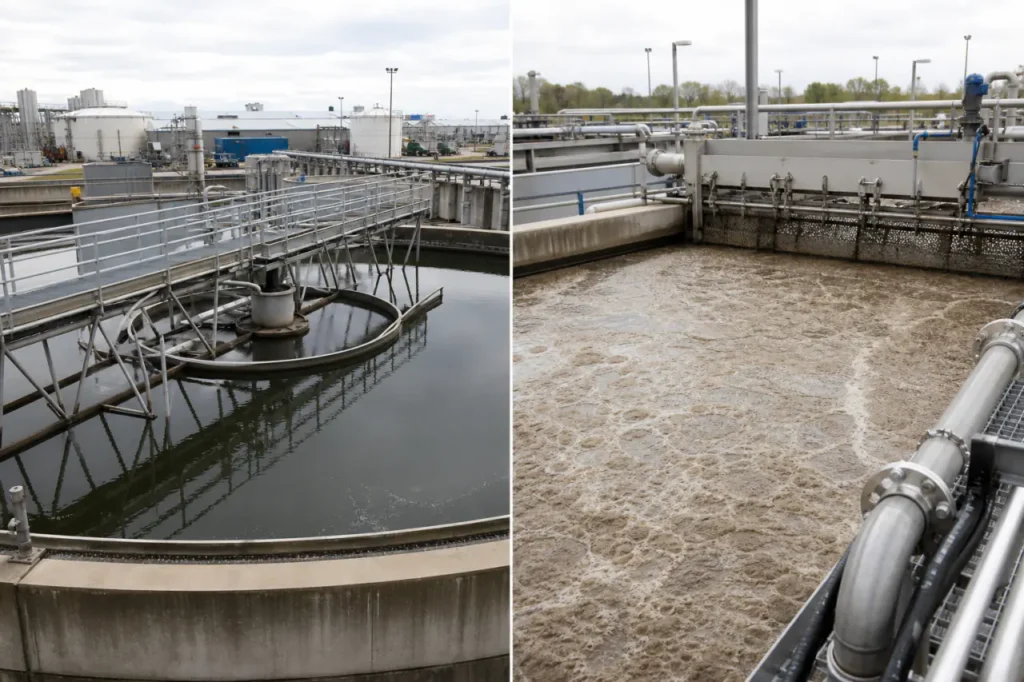
在评估一个 DAF vs clarifier for industrial wastewater, the first crossroad is specific gravity. Solids heavier than water (sg >1.0) favor sedimentation. Light solids, oils, algae, and fragile flocs need flotation.
This engineering selection guide maps the physical, spatial, and cost trade-offs so you match the separation technology to your true influent profile-before you lock in a footprint or OPEX commitment.
Operating Principles: Density-Based Separation (Sink vs. Float)
The choice is physical. Clarifiers rely on gravity to sink heavier solids. Dissolved air flotation introduces microbubbles that attach to particles, making them buoyant enough to float.
In a DAF unit, a recycle pump saturates a slipstream of clarified water with air under pressure.
When this white-water stream enters the tank at atmospheric pressure, microscopic bubbles release and collide with suspended solids. The buoyant floc rises to the surface, where a skimmer removes it.
This mechanism excels with low-density particles that would never settle within a practical retention time.
Conventional and lamella clarifiers use sedimentation instead. Water enters a basin at low velocity, and particles denser than water settle to the bottom.
Slant plate clarifiers multiply the effective settling area by stacking inclined plates, radically shrinking the footprint compared to circular basins. Our clarifier range includes both plate-based and conventional designs for heavy-solid applications.
Target Particle Characteristics and Solids Loading
Match the separator to your typical influent. If your waste stream carries low-density material, DAF wins. If it’s loaded with dense, fast-settling grit or metals, a clarifier is the natural choice.
Typical DAF-targeted solids:
- Fats, oils, and grease (FOG)
- Algae and cyanobacteria blooms
- Light organic floc (dairy, food processing)
- Petroleum residues and emulsified oils
- Any solids with specific gravity near or below 1.0
Clarifier-targeted solids:
- High-density suspended solids (TSS) like sand, grit, and metal precipitates
- Large biological flocs from activated sludge
- Heavy chemical sludge (lime softening, metal finishing)
- Solids with specific gravity markedly above 1.0
Many real wastewaters contain both light and heavy fractions. In those cases, DAF units often include a bottom auger or sludge hopper to remove settled grit while the flotation mechanism captures the light phase.
Technical Specification and Performance Matrix
The table below provides typical engineering parameters for dissolved air flotation versus a lamella slant plate clarifier. Use these as a starting filter, then validate with jar tests and pilot data.
| 参数 | DAF | Lamella Clarifier |
|---|---|---|
| Hydraulic loading rate | 3-8 gpm/ft² (7-20 m/h rise rate) | 1.5-3.5 gpm/ft² (40-80 m/h effective settling rate)* |
| cURL Too many subrequests by single Worker invocation. To configure this limit, refer to https://developers.cloudflare.com/workers/wrangler/configuration/#limits | cURL Too many subrequests by single Worker invocation. To configure this limit, refer to https://developers.cloudflare.com/workers/wrangler/configuration/#limits | cURL Too many subrequests by single Worker invocation. To configure this limit, refer to https://developers.cloudflare.com/workers/wrangler/configuration/#limits |
| cURL Too many subrequests by single Worker invocation. To configure this limit, refer to https://developers.cloudflare.com/workers/wrangler/configuration/#limits | cURL Too many subrequests by single Worker invocation. To configure this limit, refer to https://developers.cloudflare.com/workers/wrangler/configuration/#limits | cURL Too many subrequests by single Worker invocation. To configure this limit, refer to https://developers.cloudflare.com/workers/wrangler/configuration/#limits |
| cURL Too many subrequests by single Worker invocation. To configure this limit, refer to https://developers.cloudflare.com/workers/wrangler/configuration/#limits | cURL Too many subrequests by single Worker invocation. To configure this limit, refer to https://developers.cloudflare.com/workers/wrangler/configuration/#limits | cURL Too many subrequests by single Worker invocation. To configure this limit, refer to https://developers.cloudflare.com/workers/wrangler/configuration/#limits |
| Sludge consistency (% solids) | 3-5%, often pumpable | 1-3%, may require thickening |
*The high plate settling rate reflects the large projected plate area, not the tank surface area. Overall tank footprint remains compact.
Conventional circular clarifiers operate at much lower loading rates (0.5-1.5 gpm/ft²) and require substantially more space. The values above focus on compact, modern options.
Footprint, Spatial Requirements, and Flow Rates
Both DAF and lamella clarifiers solve the space problem of large sedimentation basins, but they do it differently. DAF achieves high riser rates-up to 20 m/h in well-designed units-by using buoyancy instead of gravity.
That translates directly to a smaller tank volume for a given flow.
A slant plate clarifier achieves compactness by stacking settling area vertically. Inclined plates provide a huge effective surface area within a shallow tank.
The result is a ground footprint per 100 gpm that rivals DAF, often within 20-30%.
However, DAF typically still holds an edge for very light solids that need floatation, whereas lamella units are unbeatable for heavy, fast-settling industrial particulate.
Skid-mounted and mobile containerized versions exist for both technologies, allowing rapid deployment during turnarounds, emergency bypasses, or pilot studies.
When comparing total spatial claim, account for the recycle pump, air compressor, and saturation vessel on DAF; they add auxiliary skid space.
Lamella units are largely static, but may need feed pumps and flocculation tanks upstream.
Chemical Treatment and Coagulant Dependency
Both routes usually demand chemical coagulation and flocculation. The difference lies in how the floc must behave. Clarifiers need heavy, dense floc that settles quickly, often boosted by polymer. Over-flocculation rarely hurts settling performance-it can even help.
DAF chemistry is more delicate. The goal is a pin-floc, small and light enough to attach to microbubbles without sinking. Overdosing coagulant or polymer can create heavy floc that defeats the floatation process.
Operators must control dosage precisely, and chemical cost per gallon can be slightly higher when metal salts are needed to form the right floc structure.
The payback is excellent FOG and algae removal that no gravity clarifier can match.
Cost Analysis: CAPEX, OPEX, and Automation Demands
Clarifiers are the capital-friendly choice for heavy solids. A lamella unit has no air compressor, no recycle pump, and no saturation vessel.
Its OPEX is driven mainly by sludge transfer, occasional rake drive, and polymer. In contrast, DAF brings continuous energy consumption from the recycle pump and compressor, typically 0.3-0.8 kW per 50 gpm treated.
Operational cost drivers to compare:
- Energy: DAF runs its white-water loop 24/7; clarifier energy is minimal.
- Chemicals: DAF may require more precise, and sometimes more costly, coagulant dosing. Polymer usage is usually lower than in clarifiers.
- Maintenance: DAF requires regular attention to skimmer chains, air compressor filters, and saturator efficiency. Lamella plates need periodic cleaning but have few moving parts.
- Automation complexity: DAF demands control of air-to-solids ratio, scum blanket height, and often automatic sludge blowdown. Gravity clarifiers can operate with simple sludge valve timers and optional rake torque monitoring.
When FOG or algae removal is mandatory, the higher DAF OPEX is a necessary investment. Without those low-density contaminants, the simpler clarifier wins on lifecycle cost.
Application Selection Matrix
Use this matrix to narrow the technology selection based on your primary effluent type. Still, always run bench-scale settling and flotation tests before final design.
| Industry/Wastewater Source | Best-Fit Technology | Reason |
|---|---|---|
| Meat, poultry, and dairy processing | DAF | High FOG and light organic solids; oils float, do not settle. |
| Municipal drinking water with algae | DAF | Low-density algae cells cannot be settled efficiently without massive basins. |
| Oil & gas produced water | DAF | Emulsified oils and suspended solids below 1.0 sg require flotation. |
| Metal finishing and surface treatment | Lamella Clarifier | Dense metal hydroxide floc settles rapidly in plate settlers. |
| cURL Too many subrequests by single Worker invocation. To configure this limit, refer to https://developers.cloudflare.com/workers/wrangler/configuration/#limits | Lamella Clarifier | cURL Too many subrequests by single Worker invocation. To configure this limit, refer to https://developers.cloudflare.com/workers/wrangler/configuration/#limits. |
| cURL Too many subrequests by single Worker invocation. To configure this limit, refer to https://developers.cloudflare.com/workers/wrangler/configuration/#limits | DAF | cURL Too many subrequests by single Worker invocation. To configure this limit, refer to https://developers.cloudflare.com/workers/wrangler/configuration/#limits. |
| cURL Too many subrequests by single Worker invocation. To configure this limit, refer to https://developers.cloudflare.com/workers/wrangler/configuration/#limits | Lamella Clarifier | cURL Too many subrequests by single Worker invocation. To configure this limit, refer to https://developers.cloudflare.com/workers/wrangler/configuration/#limits. |
cURL Too many subrequests by single Worker invocation. To configure this limit, refer to https://developers.cloudflare.com/workers/wrangler/configuration/#limits.
cURL Too many subrequests by single Worker invocation. To configure this limit, refer to https://developers.cloudflare.com/workers/wrangler/configuration/#limits
cURL Too many subrequests by single Worker invocation. To configure this limit, refer to https://developers.cloudflare.com/workers/wrangler/configuration/#limits.
Prepare the following data for our engineering assessment and pilot unit sizing:
- Average and peak flow rates (GPM or m³/h)
- Inlet TSS and FOG concentrations (with particle size if known)
- Specific gravity or bulk density of target solids
- Water temperature range and pH
- Available footprint and ceiling height constraints
- Target effluent quality and discharge permit limits
Once you share your influent profile, our process engineers can recommend the right DAF unit or 斜板沉淀器 configuration and propose a trial schedule that fits your site.
常见问题
Can a DAF system handle heavy settling solids?
Yes, many industrial DAF units include a bottom auger or hopper to remove grit that settles out during the flotation cycle. However, they are not designed as primary grit chambers.
If your stream contains both heavy settleable solids and light floatable material, consider a DAF with integrated bottom sludge removal rather than relying on a single-purpose device.
Are mobile DAF units effective for temporary primary treatment?
Skid-mounted and containerized DAF systems work well for emergency bypasses, seasonal algae blooms, and short-term capacity increases at food plants.
They arrive pre-piped and can usually be commissioned within days, provided there is a suitable chemical feed skid and power supply. Lamella clarifiers are also available in mobile configurations for heavy-solid dewatering.
How does automation differ between the two systems?
DAF requires tighter monitoring to maintain a stable air-to-solids ratio, correct skimmer speed, and consistent white-water saturation. Control systems typically manage the recycle pump, compressor, and scum blanket level.
In contrast, gravity clarifiers can be operated with simple sludge blowdown timers and optional rake torque alarms, demanding far less automated oversight.